Getting started
One binary, one config directory, your git repos. Forge is currently a personal research system — the flow below is exactly how it runs here, and what a release would look like.
Build and start
$ git clone --recurse-submodules git@github.com:Ronin11/forge.git
$ cd forge && go build -o forge ./cmd/forge
$ ./forge daemon start
First boot bootstraps everything under ~/.forge: the SQLite
database, a worker config, an auth token, and — the interesting part — your fork of
the base directives library, seeded with the standard roles, the flow pipeline
workflows, and starter routines. The daemon spawns its own local worker. The web UI
is at http://127.0.0.1:7340.
Point it at a repository
$ curl -X POST http://127.0.0.1:7340/api/v1/repositories \
    -d '{"path": "~/Projects/myapp"}'
Any local git checkout with an origin works; the Repos page does the same with a
"+". Drop a forge.toml in the repo declaring its checks (Forge will
propose a skeleton if you don't) — those are what L1 verification
re-runs on every attempt.
Give it work
# a small, direct task — one agent, verified, done
$ forge task add "tighten the flaky retry test in pkg/client" --repo myapp

# a real ask — planned, fanned out, supervised, merged
$ forge task add "add CSV export to every report page" \
    --repo myapp --mode plan --size M --integrate --autonomy auto
The second form is the whole machine: a planner decomposes the ask into a task DAG, builders run in parallel under write-set leases, every attempt is verified (L0–L3), green work goes through the merge queue, and a supervisor judges the settled batch — repairing, or accepting with scores.
Watch it run
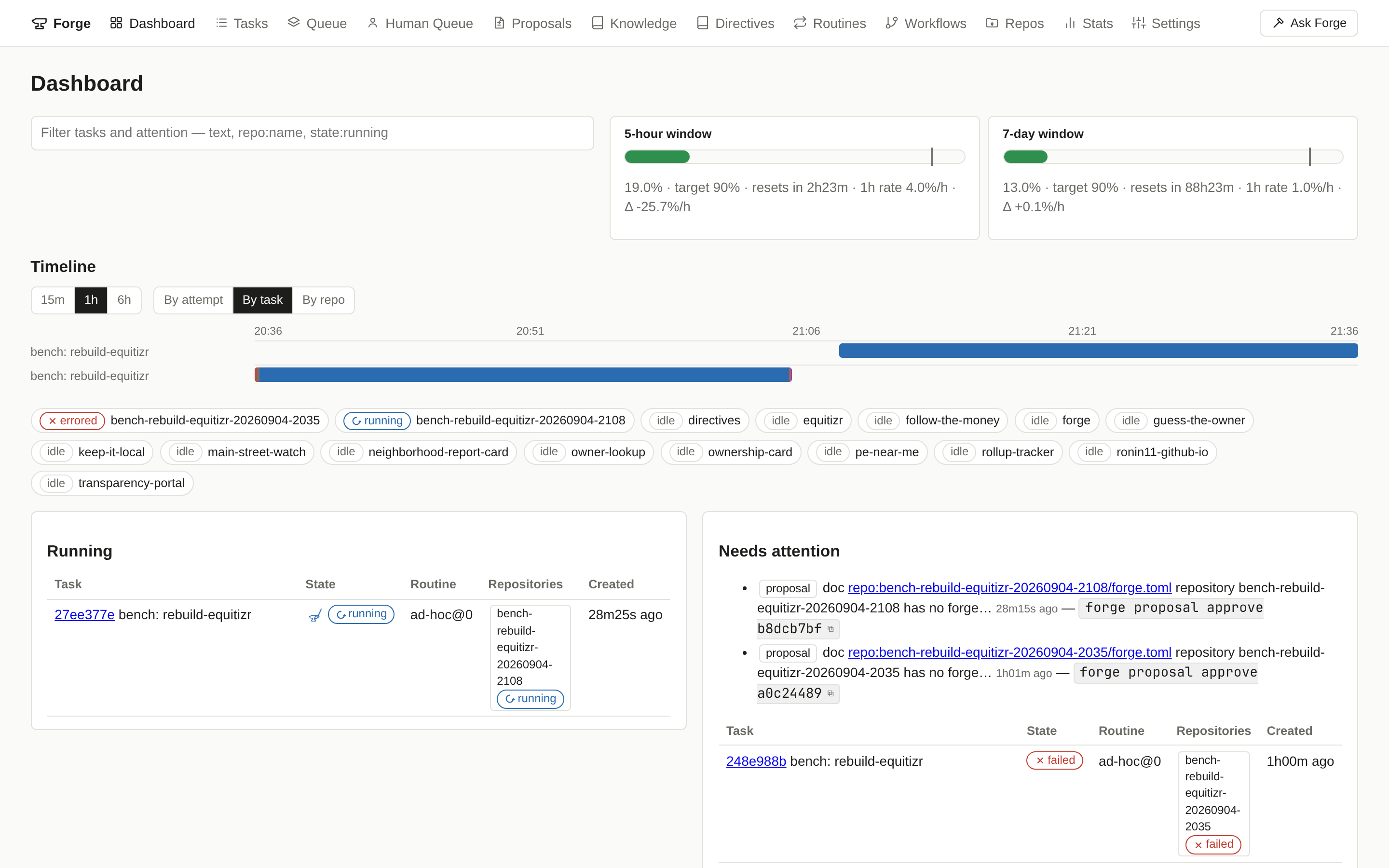
Useful commands while it works:
$ forge task show <id>        # state, attempts, verification trail
$ forge queue                # what's admitted, what's blocked and why
$ forge directives search verify   # the library, from the CLI
$ forge bench list rebuild-equitizr  # the benchmark's scored history
Make it yours
- Edit the library —
~/.forge/directivesis a git repo; the daemon hot-reloads within 30s and keeps the last good tree if you break it.forge directives updatemerges base-library improvements. - Schedule routines — a routine is a trigger (cron + envelope) pointing at a directive, script, or workflow. The seeds ship disabled; enable what you want.
- Set the budget — admission targets, hard stops, and quiet hours in
~/.forge/config.toml; the dashboard shows the windows live.